

Choosing an adjustable bed comes down to five key factors: mattress compatibility, the number of motors, weight capacity, preset positions, and after-sales service. Everything else—USB ports, massage functions, and under-bed lighting—is just a bonus.
Key Points
- An adjustable bed requires a flexible mattress: memory foam, latex, or hybrid models with pocket springs. A mattress with continuous coils will lose its shape and break.
- The advertised weight capacity includes the mattress, bedding, and the people sleeping on it. The Coastline 200 sold at Dr. du Matelas has a weight capacity of 700 lb.
- Two motors (head and independent foot sections) are the minimum required; a single motor limits the range of adjustments.
- The zero-gravity position distributes body weight and relieves pressure points in the lower back.
- According to Statistics Canada, Canadian adults aged 18 to 64 sleep an average of 7.9 hours per night, and 8.1 hours after age 65.
- 6.4% of Canadians report having been diagnosed with sleep apnea, a common reason for purchasing an adjustable electric bed.
- Insist on CSA certification: it’s an electrical appliance sitting in your bedroom.

An adjustable bed with a raised headboard changes your sleeping position without altering the room’s decor.
First, check whether your mattress is compatible
That’s the first factor to consider—even before price. An adjustable bed divides the sleeping surface into several sections, and the mattress must follow this movement thousands of times without losing its support.
Memory foam, latex, and hybrid pocket-spring mattresses fold well. Traditional innerspring mattresses, on the other hand, do not hold up well to folding: the core sags, and the comfort level declines within a few months. Thickness also matters. Beyond 14 inches, a mattress becomes heavy and stiff, and the actual angle at the head end decreases. With a manufacturer that sews its products in-house—such as custom mattresses made in Quebec—the issue of compatibility is addressed during the design phase rather than after the purchase.
Count the motors and check the load capacity
Two motors are better than one. A single-motor bed raises only the head section; with two motors, the head and foot sections move independently, allowing you to read while sitting up, elevate your legs, or combine the two positions.
The weight capacity is listed as a total limit: sleepers, mattresses, pillows, and comforters. Common models range from 650 to 850 pounds, and a king-size bed made up of two XL single bases doubles this capacity since each base supports its own load. Also check the advertised noise level: quiet motors make all the difference when two people don’t go to bed at the same time. The adjustable beds in the comfort line clearly illustrate these differences from one model to another.
Typical angles for the flat, anti-snoring, zero-gravity, and reading positions.
Common adjustable bed positions
Approximate head and foot angles
| Position | Head | Feet | Usage |
| Flat | 0° | 0° | Sleeping on your side |
| Reduction in snoring | 7 to 10° | — | Clear airways |
| Zero gravity | approx. 30° | approx. 25° | Distribution of pressure points |
| Reading | 45 to 60° | 0 to 15° | Sitting in bed |
The positions that really make a difference
Three settings handle most of the day-to-day tasks.
The zero-gravity position, inspired by the body’s neutral posture in weightlessness, raises the torso and knees to distribute the weight across the entire surface of the back. The anti-snoring position raises the head slightly, by about 7 to 10 degrees. The one-touch flat position returns the bed to its starting position without having to fiddle with the remote control.
Two or three programmable presets are enough—no one uses any more than that. A backlit wireless remote control—or a Bluetooth receiver controlled by a phone—prevents the cord from falling behind the bed every night.
Sleep, Back Pain, and Sleep Apnea: What the Data Show
An adjustable bed doesn’t cure anything, but it changes your sleeping posture, and posture plays a role in several common conditions.
Statistics Canada reports an average sleep duration of 7.9 hours among people aged 18 to 64, an average that masks the fact that a significant proportion of adults fall short of the recommended amount. As for sleep apnea, 6.4% of Canadians reported in 2016–2017 that they had been diagnosed by a healthcare professional, up from 3% in 2009. The National Heart, Lung, and Blood Institute classifies changing sleep position as a supplementary measure for mild cases, never as a substitute for prescribed treatment. When there is a genuine clinical need, the conversation begins with a healthcare professional, and the equipment follows: this is the rationale behind medical mattresses designed for healthcare settings.
Prices, Options, and Pitfalls of Shopping
The price of an adjustable electric bed depends mainly on the base, not the extras. A sturdy frame, durable motors, and a clear warranty cost more than a model packed with features.
Common features include: USB ports built into the frame, variable-intensity vibration massage, floor lighting, and height-adjustable legs. The massage feature is appealing in the showroom but tends to lose its appeal after about six months. The USB ports, on the other hand, often replace the need for a power strip. Be wary of discounts advertised against a “reference price” that’s never actually been charged, and instead ask for three key figures: the warranty period for the motors, the warranty period for the chassis, and the response time for service in the event of a breakdown.
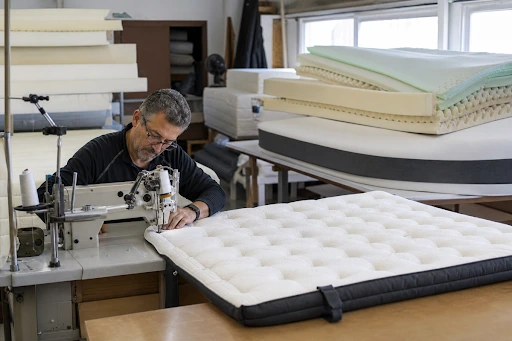
A mattress sewn in a workshop can be designed from the outset to conform to the contours of an adjustable bed base.
Delivery, installation, and integration into the decor
A fold-up bed fits through the narrow stairwells of Quebec triplexes; a one-piece frame does not. Ask before you buy if your bedroom is upstairs or in the basement.
When it comes to bedroom decor, two setups coexist: the adjustable bed placed within an existing frame, or the base left exposed on its legs. The total height—base plus mattress—must be compatible with your headboard. For a bedroom with non-standard dimensions, a custom-made bed eliminates the need for compromise. A ten-minute test in the showroom, with your own pillow, is better than any technical spec sheet.
Frequently asked questions
Can you keep your current mattress on an adjustable bed?
Yes, if it’s made of memory foam, latex, or a hybrid material, and if it’s no more than about 14 inches thick. A continuous-coil mattress isn’t compatible—it will lose its shape at the first fold.
What is the difference between an adjustable bed and a hospital bed?
The adjustable home bed is designed for comfort and blends seamlessly into the bedroom. The hospital bed features side rails, adjustable height, and transfer functions, and meets clinical requirements.
Is an adjustable bed suitable for two people?
Yes. The extra-large size, consisting of two XL single bases, allows each sleeper to adjust their position, settings, and massage without disturbing the other person.
How long does an adjustable electric bed last?
The chassis generally lasts much longer than the engines. Ask about the separate warranty on the engines and the availability of replacement parts—these are two more reliable indicators than the advertised lifespan.
Do you need a dedicated outlet?
A standard outlet is sufficient in almost all cases. Make sure the bed is CSA-certified, and keep the cord accessible rather than tucked under the base.
Sources: Statistics Canada, Sleep Among Canadian Adults (2022); Statistics Canada, Sleep Apnea in Canada, 2016 and 2017; National Heart, Lung, and Blood Institute, Sleep Apnea.